R Gopalakrishnan*
*The writer is an author. His latest book, JAMSETJI Tata—powerful learnings for corporate success, coauthored with Harish Bhat, was published in July 2024. His ID is rgopal@themindworks.me
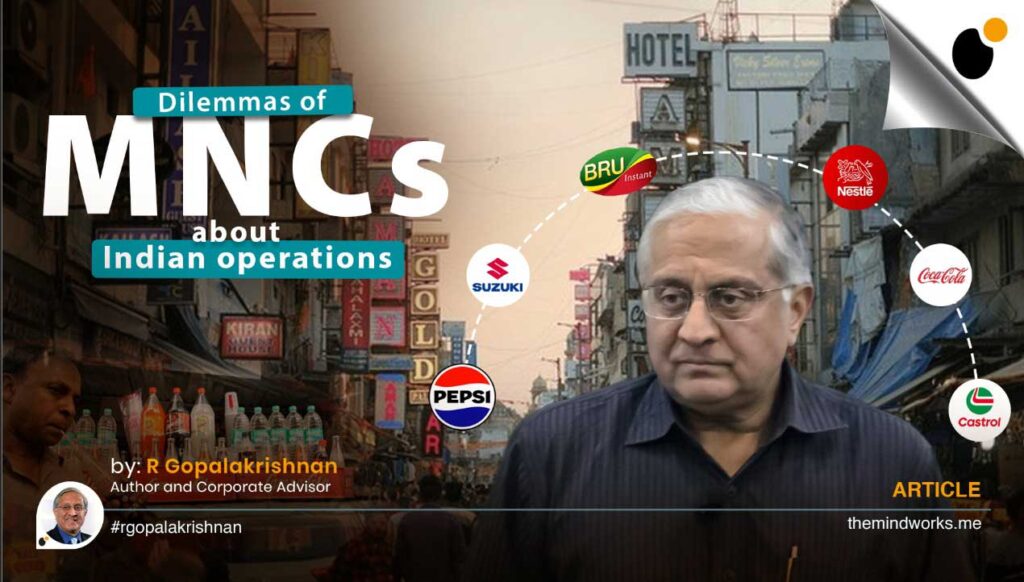
Multinational companies (MNCs) are actively interested in building a substantial business in a growing India. This was not so some decades ago because those who had historically been present in India found it to be a miniscule contributor, and those who had no presence in India found entry to be too onerous. Illustratively, in 1967, Hindustan Lever (HLL) contributed a miniscule to global profits and market capitalization. Nowadays, HLL accounts for about 25-30% of global profits, and more importantly, 40-50% of global market capitalization. India is a key market for many MNCs like Pepsi, Coke, Castrol, Suzuki, and Nestle.
MNCs face four dilemmas. First, should the business be geography-supreme (local leadership driven) or product-supreme (global leaders driven)? Second, if the subsidiary has Indian shareholding, how should governance be adapted? Third, how can the parent develop a dependable Indian management cadre that delivers the parent’s strategies? Fourth and very importantly, since the parent is usually a listed entity with performance pressures from an impatient main board, how can a balance be achieved?
During the 1970s, there was much debate about how international operations should be organised. Will an MNC succeed by rapidly transferring a well-established product across geographies (product supremacy) or is success achieved by adapted product for local needs (geography supreme)? Does India merit a structure different from other countries? The answers varied by domain and by company.
Proctor and Gamble was a late globaliser. It achieved global success by a product-supreme approach. Nestle’s expatriate CEO and global organization felt challenged by the Maggi noodle crisis until the company was headed by an Indian national. Unilever was an early globaliser and achieved global success through a geography-supreme approach. Maybe Unilever was too decentralised during its evolution over the last century. When I joined Hindustan Lever in 1967, United Africa Company (UAC), running the African geography, accounted for as much as one third of Unilever profits. The main Unilever board had three UAC directors, who even sat separately in UAC House, away from Unilever House in Blackfriars! Over the last five decades, I have had deep experience of some Indian subsidiaries of MNCs (Unilever, ICI, and Castrol), apart from, of course, a powerful Indian MNC, Tata.
In the late 1980s, CK Prahalad and Gary Hamel stormed management thinking with ‘core competence.’ They argued that every corporation has a core competence, and it should grow by exploiting and strengthening this competence. For General Motors, it was automotive technology and for IBM, it was computing machines. This thought developed into the mantra, ‘stick to the knitting.’ About the same time, I attended a Unilever conference of internal leaders at a Senior Executive Seminar at Four Acres Training Centre, in Kingston, UK.
One strand of discussion centred around how Unilever should be organised globally: product-supreme or geography-supreme. I recall arguing that, for India, geography can be thought of as core competence—management depth, distribution systems, low-cost manufacturing competence, innovation and research. Hence the Indian subsidiary should remain geography supreme.
Over decades, Hindustan Lever’s articulate CEOs constructively argued unique dispensations for the company: for example, entry into the dairy business, and later, fertilisers and chemicals; to acquire local brands like Lakme, Hamam, Indulekha, and Horlicks; holding on to Bru coffee and Lipton/Brooke Bond tea business though the rest of the Unilever world was exiting; to make product and geography work together. Anyway, its large retail shareholding imposed a special public responsibility on geography-driven leadership.
MNCs which changed in India from their geography-supreme structure to a global structure seemed to have a tepid run. ICI India, later Akzo Nobel India, whittled its presence from a massive multi-technology portfolio to just decorative paints and has now exited that also. Pharma companies like Pfizer and Glaxo created clones of an international structure in which the local board became decorative. Philips India became a shadow of its past and tried desperately to get delisted from the stock exchange. While Indian banks flourished, erstwhile MNC banks like Grindlays and Citi stagnated. I privately wondered whether these were being designed and operated based on a ‘western’ model (organize for efficiency). The truth was that new board structures, following the Cadbury Committee, introduced new pulls and pressures.
Companies which thought and acted in an ‘eastern’ way resisted such ideas (organize for effectiveness, not just efficiency). British American Tobacco (BAT) is the largest, but not majority, shareholder in ITC India. BAT would have loved ITC Ltd to exit non-cigarette businesses, but a determined Indian management fought off these attempts. ITC has emerged as the only cigarette company in the world that has successfully diversified so much that its non-cigarette revenue matches its cigarette revenue, though the profit contribution is lower.
Indian companies started to become global, focusing on giving great autonomy to local companies. Ratan Tata would say that Jaguar Land Rover and Tetley were both British companies with Indian ownership. During my years, Hindustan Lever operated as an Indian company with a British ownership. This could be an ‘eastern’ way of thinking. This eastern thinking favours effectiveness and decentralisation while western thinking favours efficiency and centralisation.
Post liberalization ‘western’ entrants into the Indian market appear to have had limited success–think of Ford, Volkswagen, Renault, for example. In contrast, consider the ‘eastern’ entrants like Maruti, Hyundai, BYD, Toyota, and Honda, which seem to have had more market success.
Growth and decline of companies happen due to multiple reasons, and the structure in its overseas markets is only one factor. I do not intend to oversimplify the subject, so my commentary should not be interpreted too literally. However, it is certain that structure and impatient parent company investors do impact executives.
When I was the Chairman of Arabia, I received a message that Timotei shampoo had become such a whopping success in Sweden that Unilever Arabia should roll it out without tinkering with the advertising and product promise. I was aghast. In the advertising, a Swedish blonde was washing her wispy, silken hair in a wooden pail with lilting music in a wooded Scandinavian countryside. How could I run that in Saudi Arabia? Then I learned that northern European hair was thin and silky with a diameter of 2-3 mm, whereas Arabian hair was thicker at 5-6 mm (African hair was even thicker at 10 mm!). Capping all this came the knowledge that Timotei in Arabic meant ‘you will die.’ The product-supreme blokes in London undoubtedly thought of me as a resisting Luddite!
Indian managers are superb at dealing with ambiguity. However, flip- flopping organization structures and short-term performance orientation can result in confusion among executives in a growth market! Add to this pressure the fact that Indian business nowadays contributes significantly to the parent.
It is fortunate that parent Tata Sons is private. It surely must be helpful to the listed ‘son’ companies!