By R Gopalakrishnan*
*The writer is an author. His latest book, JAMSETJI Tata—powerful learnings for corporate success, coauthored with Harish Bhat, was published in July 2024. His ID is rgopal@themindworks.me
I love low-profile builders of technology-led and ‘psychological market share’ businesses–hidden champions (Hermann Simon, HBS Press). Business and organizations should be designed for Deergha Ayush (long life), which connotes that business is a living entity. The metaphor of life appears in my 2017 book A Biography of Innovations–an idea gets ‘conceived’ (fetus), the idea goes through ‘adaptation’ (childhood), then a ‘prototype’ (adolescence), before emerging as a ‘product’ (young adulthood), which evolves with updates for continued success (maturity) over its life.
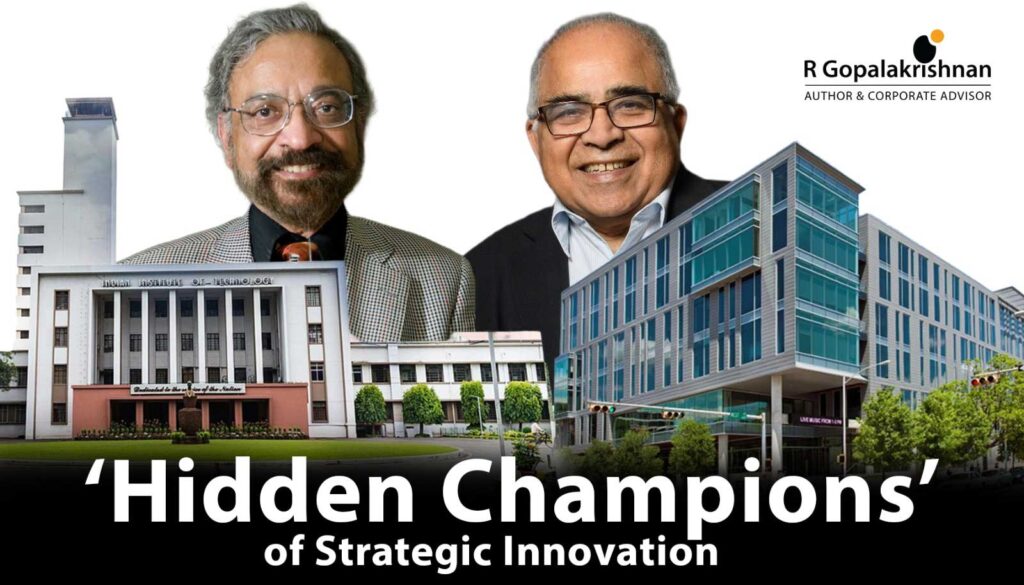
On a recent US trip, I reconnected with two contemporaries from IIT Kharagpur, both ‘hidden champions.’ Their research and innovation accomplishments count as top-class. India needs thousands like them.
44-year-old Cirrus Logic (originally Patil Systems, now publicly listed), an American fabless semiconductor supplier specializes in integrated circuits. The idea (fetus) of a fabless chip emerged in the inventor’s mind around 1980, then got adapted and prototyped (childhood and adolescence). The product was launched commercially, and the company was listed in NASDAQ in 1989 (young adulthood). The company is now headquartered in Austin, Texas. Its revenue is USD 1.9 billion with a market capitalization of USD 5 billion. Its founder is a Jamshedpur-schooled alumnus of IIT Kharagpur, Suhas Patil. He and his charming wife, Jayashree, were my gracious hosts at Cupertino.
At Kharagpur, Suhas was studious, shy and an ever-curious tinkerer. With the change in immigration laws in 1965, Suhas went to the USA to earn a Masters, ScD, and a Professorship at MIT (Massachusetts Institute of Technology). By 1973, when computer software was transformed into an ‘industry’, Suhas challenged himself to design hardware to work without defect, just like software could be developed without having to debug it. He deployed a clockless array, whereby logic gates could open and close in a decentralized manner.
Suhas recalls, “People thought that mine was too revolutionary an idea, not a comfortably evolutionary one.” Suhas was tutored in entrepreneurship by MIT’s Prof Amar Gopal Bose. I recall that Prof Bose also influenced Ratan Tata in entrepreneurship.
Suhas gave up MIT to move to the University of Utah, where he could access an existing chip fabrication facility. In those days, semiconductor chips were barely known–chips meant potato chips! Within four years, Suhas built a semiconductor chip based on dramatically accelerating the chip design process and then outsourcing the manufacture to a fab, a breakthrough at that time.
Seven years later in 1981, Suhas had created a unique intellectual property, which could design large-scale integrated circuits in one fourth of the normal time, and get the chip fabricated. His technology for a fabless semiconductor was not known to even Intel. In fact, IBM became his customer! An IPO (initial public offering) followed in 1989. Suhas came to be recognized widely as a fantastic inventor. Cirrus Logic became a powerful entity, endowed with its unique intellectual asset.
What next? Approaching sixty, Suhas desired to propagate and perpetuate the social value of enterprise. He co-founded The Indus Entrepreneurs (TiE) with Kanwal Rekhi and AJ Patel to nurture the next generation through a network of mentors and advisors. TiE now has over sixty centers, including several in India. Indians account for one third of the startups in Silicon Valley. This story is a testament to disciplined innovation, as also to the biological model for innovation.
Later during my visit, I met another contemporary, Anjan Bose. Regents Professor Anjan Bose recently received a lifetime achievement award from the Institute of Electrical and Electronics Engineers (IEEE). He was recognized for his pioneering contributions to automation and control of power grid operations, training, and education all over the world.
Anjan worked on the electric power grid for more than 50 years–in industry when he pioneered the computerization of the control centres that operate the grid, and then in academia where he developed the simulators for training grid operators.
He has been an advisor to the US Department of Energy and to Grid India on power grid operations. Michael Baumgartner, Member of US Congress from Anjan’s home state of Washington, made an extensive mention of Bose’s work in the House of Representatives!
These are ‘hidden champions’ of strategic research and innovation. They are worthy of emulation within Indian industry, maybe even a Padma!