By R Gopalakrishnan*
*The writer is an author. His latest book, JAMSETJI Tata—powerful learnings for corporate success, coauthored with Harish Bhat, was published in July 2024. His ID is rgopal@themindworks.me
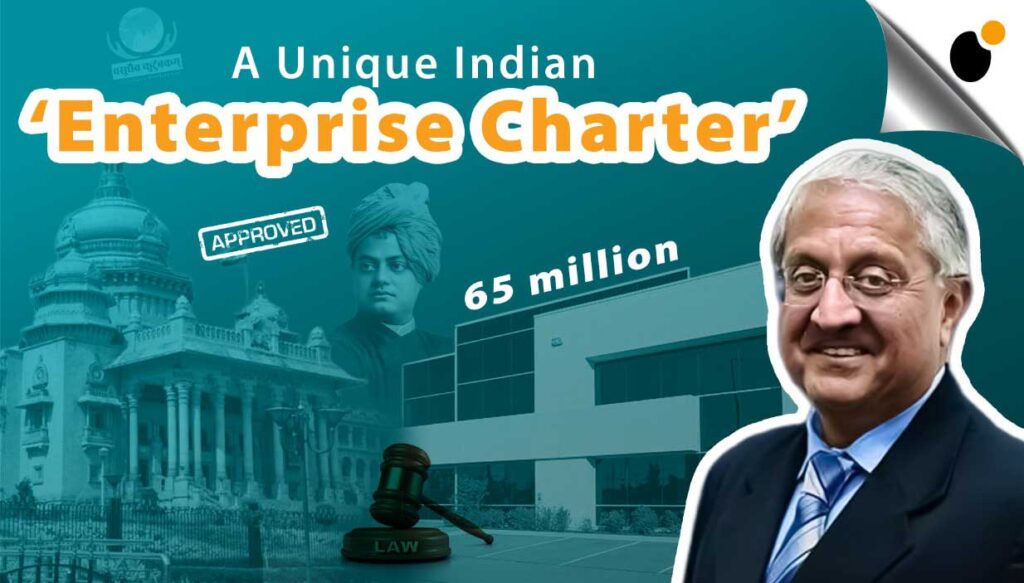
Enterprise—large, medium, small, micro, start-ups, manufacturing, trading, services, public, private—is the oxygen of any economy. Without enterprise, there will be no economy. India has about 65 million enterprises as per records. Only 20,000 uses more than Rs 10 crores capital, of which only 5,000 are listed. Just 250 firms account for about two thirds of aggregate market value. Daily stock market excitement is about few newsy companies. India’s enterprise canvas is a vast array of small units with just a handful of significant companies. What we need is maybe 10,000 actively traded enterprises in manufacturing and services, and 100,000 medium and small enterprises with distinct capabilities in a global context, as we find with Japanese craftsmanship and German Mittelstand.
For a developed India, many vectors must be activated concurrently, and India is on this trail. However, we need far more urgency, focus, and passion: an “Indian Enterprise Charter”, almost like an Indian Constitution, may help focus. It must be a living document with a deep sense of enterprise morality; a document which is adaptive, is constantly evolving in line with our distinct cultural ethos. What is the strategic role that enterprises should play in our economy? What kind of enterprises does India wish to foster? What is their desired behavior and approach to nation-building? How will state and central governments play an enabling role for large and small companies? Just like the Preamble to the Constitution, the Charter requires a Preamble, a value-based philosophy.
The Indian Constitution has about 150,000 words. It was enriched by ideas from diverse segments of population, and the Preamble is a brief statement that outlines core values and the philosophy. Likewise, the Charter needs a Preamble, which enshrines core values and a philosophy for enterprise promotion, quite distinct from procedures and rules.
Enterprises add strategic strength by conforming to certain highly desired attributes such as: (i) follow laws of the land (ii) not constantly mired in controversy (iii) think and adapt for the long term (iv) focus on R&D, innovation, capital investment and strategy rather than reinforcing political connections (v) work and earn for societal benefit (vi) follow exemplary standards of governance (vii) spread social good by creating employment, inculcating skills, caring for employees and associates, and adapt to changing market imperatives. Such ideas can provide the basis for a well-thought-out Preamble and Enterprise Policy.
The crises in societies can be attributed to inequality, an imbalance along multiple dimensions. Their manifestations are:
- Inequality of economic being: Gini indices and perceptibly yawning gaps between the rich and poor, between communities and within communities
- Inequality of social conditions: The widespread prevalence of inequality due to prejudices of social status from race, religion, and caste despite national laws against such practices.
- Inequality of communications abilities: Polarization of society has created segments of ‘hearing-challenged’ leaders.
- Inequality of institutions: The traditional institutions of governance are eroding in an atmosphere of ‘winner takes it all’
- Imbalance in public morality and ethics: The civic background of candidates in politics is hardly an example to the people of various nations.
Government too has an important role. It is incredibly difficult to do run an enterprise in India. It is tough to get speedy and prompt justice in commercial disputes. As many as half the commercial disputes in the country have the government as a party.
China has an engineer-led culture—80 percent of governors, mayors, and party secretaries are technocrats. America is a lawyer-led culture–50 percent of US Congressmen are lawyers. India is a politician-led culture, of whom few can claim to be technocrats. As demonstrated by some southern states, bureaucrats can do a decent job if they are left somewhat alone by their political masters.
India needs a whole new mindset of enterprise promotion is needed conforming to a national philosophy of enterprise and service. It is at the core of India’s civilizational heritage. It is worthwhile to recall lessons in this regard from the Upanishads and from Swami Vivekananda’s philosophy, which has not been sufficiently reinterpreted for the modern mind.
To conclude philosophically, India’s Enterprise Preamble and Charter should call on entrepreneurs to treat humanity as one, the earth as their home, and to live in peace despite differences. The Upanishadic injunction Vasudhaiva Kutumbakam (The world is one) says it succinctly and eloquently and has been quoted by political leaders from Jawaharlal Nehru to Atal Bihari Vajpayee to Narendra Modi.