R Gopalakrishnan*
*The writer is an author. His latest book, JAMSETJI Tata—powerful learnings for corporate success, coauthored with Harish Bhat, was published in July 2024. His ID is rgopal@themindworks.me
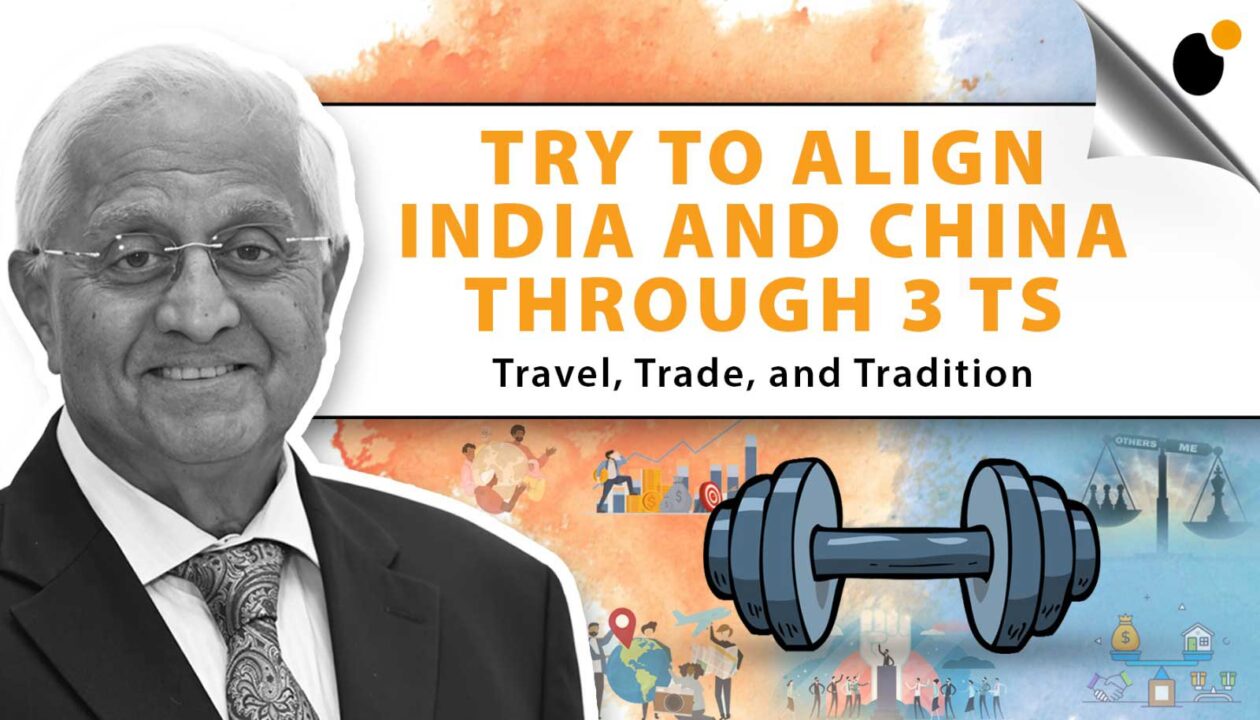
India and China have had close people-to-people relationships for centuries. Chanakya and Sun Tzu were approximate contemporaries, though one hundred years apart! India has historically been best at relationship-building with other nations through travel, trade and thought. The three Ts were strong glues. The Tea and Horse Road carried a flourishing trade. The spread of Buddhism had a mercantile streak (Devdutt Patnaik, New Indian Express, 20 April 2025). This newspaper carried a relevant article just last week about a syncretic vision to heal our divided world (New Indian Express, 1st June).
When a truncated India encountered a unified China in the 1950s, the frontier politics of British India opened differences. Differences are under eight decades old after centuries of soft power influences both ways. Over the coming decades, there is potential benefit if Chanakya and Sun Tzu can work together through business. For two large neighbours, that is worthwhile.
A business perspective
My experience of China is only through business. Trade, travel, and thoughts bring people together.
A young Jamsetji Tata, founder of Tata, went for training to Shanghai around 1860. On my first visit in 2009, I learned that Avan Villa at 458, Wulumuqi North Road in Shanghai was owned by Bejan Dadabhoy Tata, a distant uncle of JRD Tata. As a Tata Director, I visited a subsidiary called NTACO in the Jingning Industrial Economic Zone near Nanjing, making plastic injection-molded automotive components. I also attended the inauguration of NTACO’s second unit near Changshu in 2015; and later, a third company was set up to trade in automotive components. Tata in China has annual revenues of USD 8 billion and employs thousands through Tata Consultancy, Jaguar Land Rover, TACO, Tata Technologies, and Tata International. A joint venture, Chery-JLR Automotive, manufactures cars in Changshu.
Relationships
Tibet is claimed by China to have been part of them until the fall of the Qing around 1911. Therefore, in 1950, China took over Tibet. The role of India in extricating the Dalai Lama India to India caused tension with China. In 1962, China and India fought a Himalayan war. Since then, there have been skirmishes and periodic tensions, leading up to the clashes in 2021 in the Galwan Valley. For six decades now, India and China have viewed each other with suspicion.
In 2007, Professor Tarun Khanna of Harvard Business School felt that the opening of the Nathu La pass in Tibet reactivated the world’s highest customs point for trade between India and China (China + India: The Power of Two, Harvard Business Review, December 2007).
Both nations now seem to desire longer term relationships though the terms are yet to develop. The two foreign ministers met in Kazan, Russia in 2024. The meeting was reported as “a tactical thaw rather than a strategic shift away from Sino-Indian rivalry.” (Tanvi Madan, Brookings, 29th October 2024).
Over thirty years, despite border tensions, trade between India and China has grown from USD 0.25 billion in the 1990s to over USD 120 billion in 2024, albeit in a very unbalanced manner.
Connections
Between 1920 and 1940, twenty-seven books were published in China based on Gandhi and Gandhiism.
In 1906, when the government of Zanzibar and East Africa enacted an Asian Ordinance, 1100 Chinese stood beside 8000 Indians to protest it. (Soumendra Banerjee, The Statesman, 10th February 2020).
At the centenary celebrations at Visva Bharati University, Tagore’s 1924 statement from his China visit was recalled, “India has been one of China’s closest relatives, and China and India have enjoyed a time-honoured and affectionate brotherhood.” (Dev Raturi, Global Times, 2nd June 2024).
Apart from people-to-people contact, there are geographical and geopolitical factors.
Valeriepieris view
It is a circle around the South China sea, encompassing China, India and some southeast Asian nations. Ken Myers of Texas first drew this circle about two decades ago and his nom de plume, Valeriepieris, got attached to the idea. It was refined by Professor Danny Quah, now Dean of Lee Kuan Yew School of Public Policy, Singapore and by Professor Riaz Shah of Hult International Business School.
Using data from United Nations Population Prospects, 4.2 billion people are estimated to live inside the circle as compared to 3.8 billion outside. However, the land area is only 15 percent of that of the planet. Imagine the density. Tightly packed people of China and India must either adjust to live peacefully, or fight to extinction. The choice is obvious.
Arctic View
Watch the earth from a position directly over the Arctic Circle. America and Russia are closer to each other than we realize. Both eye Greenland as strategic. In the gradually melting shores of the Arctic Ice lie lands with rare earths, minerals, gas and oil, no doubt, difficult and expensive to mine. This relationship could develop as competitive or collaborative. The USA-Russia-China relationship is quite a different subject from the focus here of the India-China one.
Lessons
Both nations are culturally strong and are aware of their cultural heritage. Both are economically marching towards retrieving their past strength, albeit being at different stages and outcomes. China has been quiet, but strong in discipline and pragmatism. India has been noisy, but strong in creativity and ideas.
Like China has done, India too must invest much more in R & D to make this opportunity come alive. Consider that since 2000, China’s investment in research has grown by 18 X, growing to over $750 billion. No wonder that China has become highly competent in new technologies and research. Chinese technology joint ventures in India in electronics, automobiles, pharma, financial services, and artificial intelligence are promising! This can work only if China too wants it, and policies must change in this regard. China developed rapidly by combining Western technology with Chinese manufacturing. India could combine Chinese technology with Indian manufacturing, initially producing for India, but later, for export as well.
There is a role for business leaders and government through promoting travel, thoughts, and trade. Study by university students, tourism, joint ventures rather than just short-term trades, all of these and more help. They are proven instruments in geopolitics. Circumstances make allies of nations.
Will it happen in the short term? Probably not. Some leaders must change from competitiveness to collaboration mentality. Fresh thinking can accelerate the momentum. The good news is that there are signs that leaders are thinking about the matter.
It is entirely desirable if India and China play their roles in getting Chanakya and Sun Tzu to converge.