By R Gopalakrishnan*
*The writer is an author. His latest book, JAMSETJI Tata—powerful learnings for corporate success, coauthored with Harish Bhat, was published in July 2024. His ID is rgopal@themindworks.me
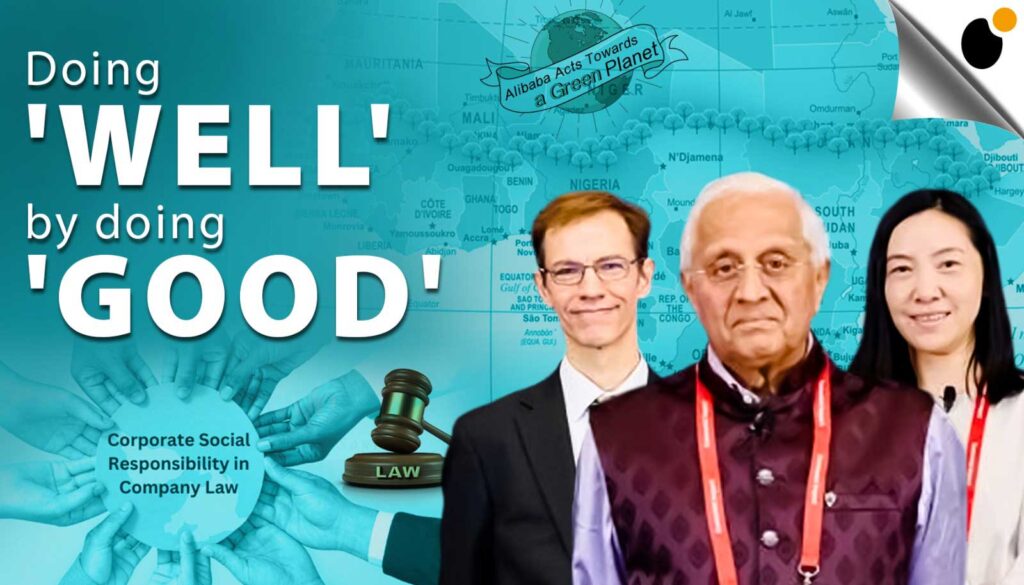
More than a decade ago, Hindustan Unilever (HUL) unveiled its purpose statement as “Doing well by doing good.” The company’s program included Integrated Sustainability Strategies, Purpose-driven brands, Making a tangible positive impact. The purpose had evolved progressively from the 1950s, “Hindustan Lever serves the home” and the 1980s, “Relevant technology.” After experiencing my TATA career, the idea of stakeholder management strengthened in my mind. I point this out because “purpose” is a mantra for contemporary management gurus!
Last week I attended a Hong Kong conference on how businesses can achieve success by aligning profits with purpose. With support from the Institute of Philanthropy, Economist Impact undertook a rigorous process of research, interviews, advisory board discussions, and expert roundtables. The outcome was their thought-provoking publication, “The Business of Doing Good in Asia.” (copy available from asia@economist.com). The report captures how enterprises across thirteen Asian markets are moving beyond traditional business models, experimenting with approaches that integrate commercial ambition and social responsibility. Moderated by China economics editor of The Economist, Simon Cox, the Secretary General of the Alibaba Foundation and I exchanged ideas in a panel. Our conversation centered on a vital question: What does it truly take to thrive by doing good?
The Anglo-Saxon mindset still entertains the Milton Friedman doctrine of business being solely for shareholder profit. In my experience, this approach is not helpful for the longevity of business organizations. There is a research report on this by Austria’s Living Machine Institute (www.livingmachine.org). Unfolding differently from the West, Asia’s path has a more balanced perspective—one that recognizes the power of business to drive not just economic growth, but also social transformation. It is a trend that deserves close attention in the years ahead.
Abroad we might misjudge the relationship between government and private sector companies in China. When Ant Corporation (of Jack Ma fame) planned its initial public offering in 2021, the Chinese regulator came down hard on some of the practices in Ant Corporation, thus aborting the IPO. This apparently does not mean that China is against Ant Corporation. In China, corporate good is often aligned with government priorities under the Common Prosperity program. Here is an example.
Ant Foundation and its affiliate, Alibaba Foundation, and many others offer support to the government’s seventy-year project (Great Green Wall Project) to retard the desertification of Beijing from the Taklamakan and Gobi Desert. Together these deserts have an area equivalent to slightly under half of India’s area! The Great Green Wall is strips and patches of 66 billion trees—yes 66 billion–planted in vast swathes across the north of China. These trees act as wind breakers to the dust storms that frequently blow across the area from the Gobi and Taklamakan deserts. (https://youtu.be/Jk39G8jY8V8?si=lREesCyUZ2DG-Mjz). In 2021, the tech giant, Tencent established the Sustainable Social Value organization (SSV), an internal engine leveraging its technological and business capabilities to deliver social value. This company’s communication platform (Weixin in China and WeChat elsewhere) connects over a billion people yielding an opportunity to drive real social good platforms.
India has its own long tradition of business doing social good. These are deeply embedded in family businesses, partially captured in the series The Story of Indian Business, edited by Gurucharan Das and published by Penguin. Social good has been natural among Kutchi Bhatias, Tamil Chettiars, Gujarati Jains, Marwari Banias, Gujarati Bohris, Kerala Christians, and several others. Being the only nation to have a compulsory CSR contribution by corporates, Indian business is evolutionary in its approach.
What India needs is an overhaul of its public enterprise philosophy, as distinct from rules. From the 1950s, policy meant a bureaucratic listing of who can do what in enterprise, how much an enterprise can produce, with a long list of dos and don’ts. These days it is focused on slogans like Make in India, Startup India, Ease of Doing Business, and Production Linked Incentives. Where is philosophy?
India needs a philosophical Business Policy (Business Rules are different). Philosophy should demand the establishment of institutions with seeds of longevity, with high perpetuity value and ethics, with human-centricity, modernity and compassion. Even Buddha advocated Maitri (love) and Karuna (compassion) in all activities. Social contribution will then be naturally integrated with tradition and modern enterprise leadership.
Long ago in 1893 in Chicago, Swami Vivekananda had espoused a four-point formula for enterprise to flourish: be self-aware, protect resources, serve others before self, and take firm decisions but execute with compassion! It is still valid and desperately required in India.