R Gopalakrishnan*
*The writer is an author. His latest book, JAMSETJI Tata—powerful learnings for corporate success, coauthored with Harish Bhat, was published in July 2024. His ID is rgopal@themindworks.me
Industrialist Harsh Goenka placed a social media post that as a patriot, he is utterly confused. He first boycotted Chinese noodles, then Turkish baklava, then cancelled his Maldives holiday, and recently stopped consuming McDonald’s and Coke. He admits that he is a confused desh bhakt. His voice is that of many citizens. The world has indeed become too complex.
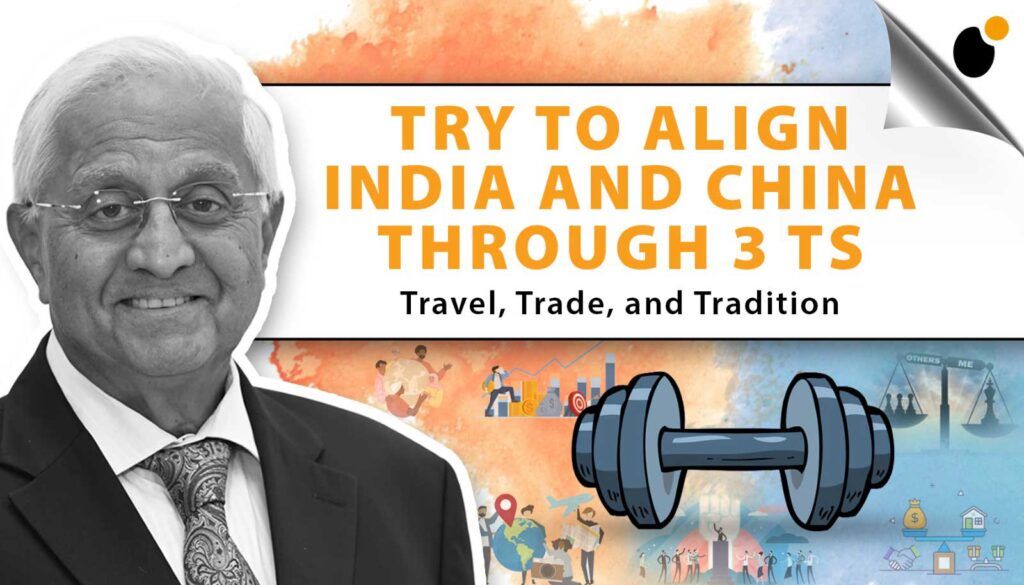
Travel, trade, and tradition are three Ts that bring nations together. This piece is about India and China. At the recent Tianjin SCO conclave, Prime Minister Modi reportedly had ‘positive’ meetings with the Chinese leader. Some observers are gleeful because bullying has been rebuffed. Memorializing the opening of Japan by Commodore Perry in 1854, others feel that India should use this Perry moment to reform. Yet a third group cautions that India should tread carefully. Perhaps all three perspectives have some merit.
Any two nations connect like a dumbbell. On one side, there are easy-to-measure factors like (i) trade and investment, (ii) travel and people exchange, and (iii) ideas and culture interchange; on the other side, there are difficult-to-measure factors like (i) politics and ideologies (ii) national self-interest and (iii) mutual benefit. The dumbbell must be stable for it to be effective.
Before the US meltdown, I wrote two op-ed articles in this paper advocating that India must build relationships with China through travel, trade, and thoughts. Many warmed up to the idea, few were critical. Too much suspicion exists between the two countries. In a brief review of my articles, the doyen of foreign policy and author of a recent book, Echoes of the Past, Ambassador Lakhan Mehrotra, expressed his valuable thoughts.
He felt that “the idea of India and China working together, based on their great civilizational bond, and following a mutually open-door policy in line with their historical fraternity, were interesting.” My citing Chanakya and Sun Tzu prompted him to point out that both had advocated acquisition of military capabilities for defense against enemies, simultaneously following the diplomatic route. Both thinkers advocated constantly adding to the power of the state to become the commanding force of its time. This merits India’s attention. For India’s foreign relations to grow stronger, the Indian economy must grow stronger.
China has become the commanding force in Asia. India is not there. India needs to grow for two decades at 4-5 percentage points higher than global growth (as China did for twenty years) before flexing muscle. China will not treat India as an equal; India has no choice but to adjust to this reality in the short term. This asymmetry of power increases the challenges for India’s cooperation with China. As a celebrated student of Sun Tzu’s The Art of War, Mao would probably have endorsed China’s policy of two steps forward one step back. The cement in relationships, trust, is missing, given our experience of 1962 and 2020. That is why India must take cautious steps and not to go whole hog.
A somewhat unique feature of China and India is that they have coexisted peacefully for centuries. Their differences are of relatively recent origin. In fact, the serious difference is about the relevance of colonial MacMahon line, which the Chinese just do not accept. For India, it is, of course, not a small matter. Both nations ar culturally strong, and aware of their cultural heritage. Both are restoring their past positions of strength, but China is well ahead of India.
May be India can explore its own idiosyncratic approach by combining Indian capabilities with Chinese technology. This is not a matter of national ego. Indian private industry needs to spend three times of the current expenditure on research and technology-building. China reportedly started by copying and imitating, but almost simultaneously built its own global R & D competencies. India Inc has failed to do this for decades.
China has soared in skills, research, and academics. China boasts twice the manufacturing capacity, it dominates in electric vehicles, fourth-generation nuclear reactors and now produces more active patents and top-cited scientific publications annually. (Foreign Affairs, Kurt M Campbell and Rush Doshi, 10 April 2025). Militarily, China features the world’s largest navy, bolstered by shipbuilding capacity which is 200 times larger than the USA.
Already the Indian government is approving selectively Chinese technology joint ventures in India in the fields of electronics and automobiles. Pharma, financial services, and artificial intelligence could follow!
The richness and resilience of people-to-people relations between nations influences relations. It is in this context that travel, thoughts, and trade feature. Study by university students, tourism, joint ventures rather than just short-term trades, all of these and more help. They are proven instruments in geopolitics.
India must play the long game like the Chinese Weiqi game, invented thousands of years ago. Some leaders must change, bringing in fresh mindsets. Coming closer is possible. Circumstances make allies of nations. Converting suspicion and competition to trust and collaboration is not easy. If business pragmatism drives other major nations, why not have it drive India and China to work together?