By R Gopalakrishnan*
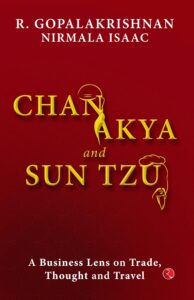
*The writer is an author. His new book, CHANAKYA AND SUN TZU: a business lens on trade, thought, and travel, coauthored by Nirmala Isaac, has been published by RUPA in Feb 2026. His ID is gopal.mindworks@gmail.com
Times are turbulent. The real question is about how to respond to huge turbulence.
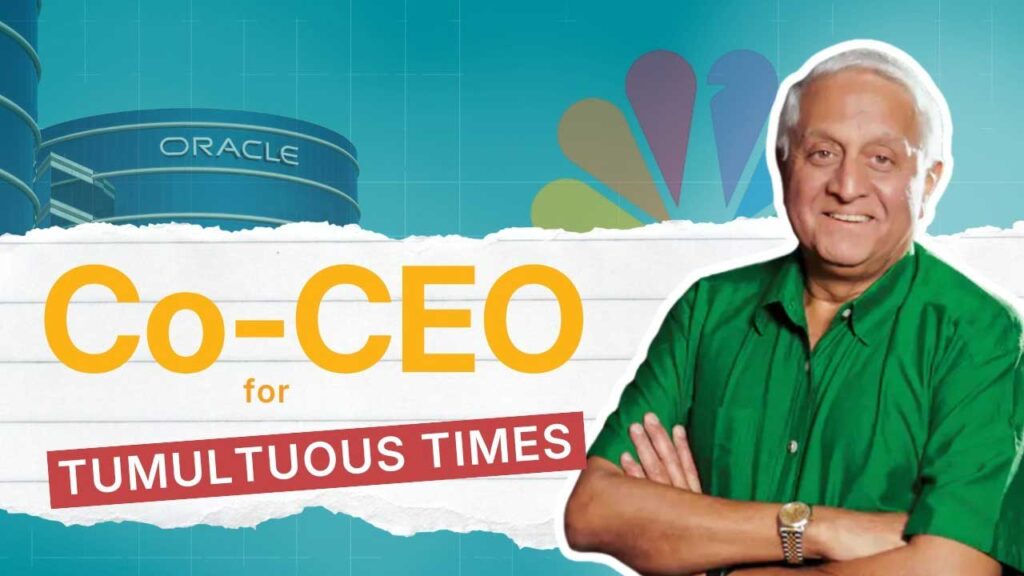
As a response, in September 2025, three well-known corporations adopted a co-CEO system: Oracle, Comcast, and Spotify. The two CEOs divided up the responsibilities; in a particular case, one CEO took on existing and new projects, while the other took on global growth opportunities and new business development. This seems to work for them, though it is unclear where the buck stops. Earlier, Netflix, Waymo, Marks and Spencer, and Deutsche Bank had been adopters.
During the 25 years from 1996 to 2020, among the S&P 1200 companies, fewer than 100 were run by co-CEOs. Hence, the concept is rare in the real world. Some published research suggests that of 87 American companies that researchers analysed, the co-CEO system cohort delivered 40% higher returns than the cohort with solo CEOs. This management research seems to be a dubious conclusion, at least to me!
There are many consultants and opinions on how companies should cope with tumultuous times. Like many experienced leaders, I too speak to curious corporate leaders. However, the recent article by Pilita Clark (Financial Times, 3rd May), exploring why co-CEOs might suit tumultuous times, caught my attention. That had not been viewed by me as a panacea for tumultuous times. However, I do have experience of working in a co-CEO environment; hence, I have had a longtime interest in such institutional duality.
Unilever globally had a CEO-structure of three directors, which they called ‘Special Committee.’ This operated continuously from 1929 when the British and Dutch arms merged into one. After 70 years, this three-man CEO structure was scrapped because the organization was tardy in responding to customer and market demands. In 2026, even after scrapping the Special Committee, Unilever’s search for agility and speed continues. May be Special Committee was one of several problems—or may be not the problem at all!
How did the Special Committee operate? My perception is based on my professional interactions. The British arm, Unilever plc, and the Dutch Unilever NV, each had a chairman. The legal relationship between the British and Dutch arms was encoded in complex agreements which the lawyers supervised. There were, as always, personal and cultural peccadillos. The board was common and accounts were presented together. The two chairmen took turns at chairing the Unilever board meetings. The third director had the unobtrusive title of Member, Special Committee.
The third member played a valuable and balancing role between two opinionated and strong-willed chairmen. The third member rarely became Chairman of either company but played a constructively collaborative role. Differences between the two chairmen would arise as they do between corporate leaders (even husband and wife). Resolution inevitably requires that discussion is never abandoned. This helps the institution to be effective, though process could be inefficient. Unipolar and efficient CEO stewardship is not without attendant risks like ego, rigidity, and power intoxication.
When I was heading Unilever Arabia, I had visits from both chairmen, Mike Perry and Floris Maljers. Floris was aware of Mike’s visit notes, and he focused on a complementary agenda. When I had to present my action plan for the Arab market to the Unilever CEO, all three members of the Special Committee were present with Ronnie Archer as the third member.
Things changed at Unilever. The company first abandoned the co-CEO structure and opted for a single CEO; later, the company changed the listing of Unilever from London and Rotterdam to one stock exchange, London, only. My impressions of events thereafter are shaped by the views of former Directors who had experienced both the co-CEO and single CEO structure. Several bemoaned the abandonment of the co-CEO structure, which they felt offered a fine balancing pivot through the unique third member. Others held that the change was necessary, and relevant for tumultuous times. The debate perhaps continues.
When I worked at Tata Sons, I encountered a different sort of dual influence structure. For Tata Sons and Tata Trusts, the enterprise and philanthropy were integral to the deeply held organizational philosophy. For many decades, the same person chaired both, effectively making it a seamless system. Recently, TATA has been experiencing the pangs of separate chairmen, a duality that is new to Tata.
The solution does not lie in thinking about public listing or surname. That would be missing the wood for the trees. Moving from a single influence structure to a dual one needs great maturity, conversations, and I emphasize, privacy. Leaders must be rich in listening skills and diplomatic in speaking skills. Everyone must know where the buck stops in the dual structure. These are lessons that can be learnt with great benefit.