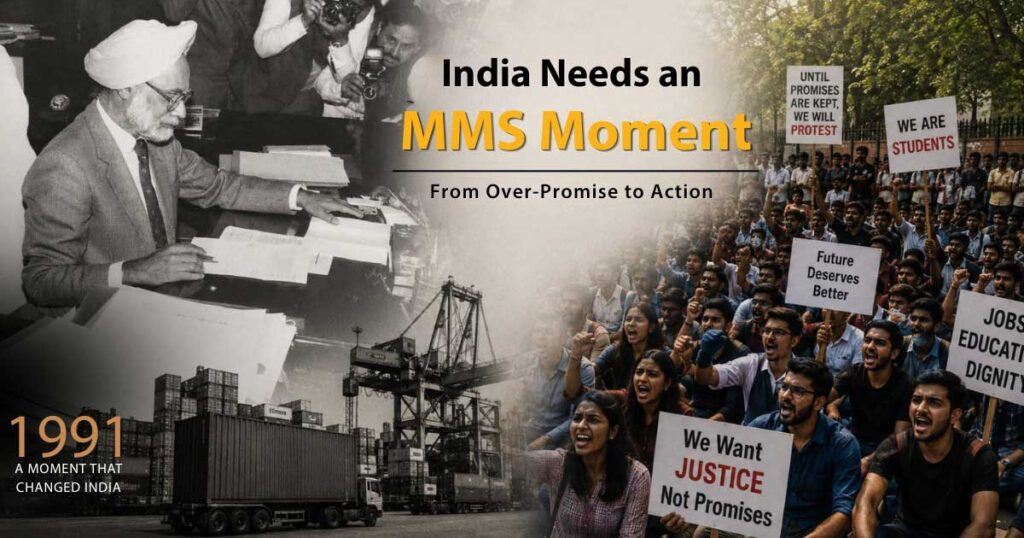
Leaders everywhere are faced with the compulsion to think out of the box and solve problems which have accumulated like atherosclerosis in the administrative system. We call this the MMS moment (Manmohan Singh) to commemorate the architect of liberalization.
But where do you begin? A leader can start first, by deep listening with empathy, and second, by delivering what is promised. Leaders everywhere must learn to listen with empathy. But who runs a listening skills course for leaders? Since youth have ‘finally’ been listened to, older folks should also be listened to!
The oldest of us is a nonagenarian. The other two authors were born about ten years later. We enjoyed professional careers and retired from formal careers sometime in the last 20 years. Our current preoccupation is to be thankful for the lives we led, to feel immensely proud about being Indian, and to hope that our future generations will feel even prouder in the coming decades. In this rare joint writing, we draw attention to why some questions seem to linger forever, suspended in the gap between promise and delivery.
Our parents were highly preoccupied with placing food on the family table. They experienced the turmoil of colonialism, world war, famine, partition, and other convulsions which touched their lives. We grew up in an India characterised by a controlled economy, where everything was in short supply—grains, bread, milk, steel, transport, and communications. We led more plentiful lives compared to our parents. Our sons and daughters have lived even better lives than we did, spurred by better availability of earnings, savings, travel, and technologies. If progress were linear, there is no need for us to worry about the future. India must be on the right track.
But it also may not be so. Politics, governance, and geopolitics form a complex spaghetti and do not unfold in a linear manner. We belong to a singularly fortunate generation that has experienced the survival, indeed the successful growth, of independent India. Many nations gave up democracy or transformed into autocracies. Ours has remained democratic, despite some inevitable weak spots and frailties. This is a remarkable achievement for a country as large as ours
Leaders of all varieties assume that being appointed or elected implies that he or she automatically becomes a good listener. From our careers, we can confirm this to be invalid. In fact, the stronger the leader the less likely that he or she listens. Evidence in the public arena is visible from the national leadership in, for example, USA. With much less than majority of the popular votes, leaders often behave as though they have overwhelming support.
If problems linger, protests and civil disturbances erupt. Our generation has experiences and memories of Gandhiji’s and JP’s methods, but the emerging generation has little memory of those. The emergence of the CJP (Cockroach Janata Party) bears evidence of this dramatic change and new perspective of youth. Dissatisfaction multiplies when leaders do not listen with empathy; coupled with an exploding social media, leaders face many challenges.
The problem of exam leaks is not a recent issue: in the last twelve years, we have experienced 1.25 leaks per month! It is no consolation that they occurred earlier also. Now there is an Exam Reform Committee. What happened to the National Education Policy (2020), Malviya Mission Teacher Training Programme (2023), and K. Radhakrishnan Committee (2024) on accreditation? The remarkable instant reaction of 20 million people to a random Instagram message is indicative of a much larger problem than a dysfunctional examination system.
Associated with it are the lingering developments relating to other youth anxieties: massive educational expansion accompanied by excessive privatisation and skyrocketing costs, deteriorating standards of education, unavailability of jobs and over-qualification for low-level jobs. Youth’s aspirations have been raised but delivery does not match the higher aspiration. Luckily, issues of housing, food and women’s income are mitigated by a variety of schemes run by government.
Nothing is more dangerous than reasonably fed youth who find little meaning in their lives and prospects. In the last decade, matters have deteriorated or, at best, stayed static. If the CJP protest indicates anything new, it is the unacceptable gap between promise and performance in ways that touch individuals in the population.
The last decade has raised hopes rapidly along many dimensions. No earlier generation been promised so much—dramatic improvement in educational standards, elimination of corruption in public life, credit into bank accounts by recovering illicit wealth from abroad, benefits of demonetisation, doubling of farmers’ income, reducing import dependence on crucial food-related items: fertilisers through nano fertiliser, edible oils through large-scale plantations in the north-east, and augmenting supply of pulses by some plan. Though our GDP growth in the last decade or so is similar as the previous 20 years, we are now acclaimed as the fastest-growing economy. But this is not enough if the promises made with panache are met for the growing aspirations of our youth and the general population.,
Thus, we have a burgeoning youth, not gainfully and satisfyingly preoccupied, faced with long-lingering outcomes out of governance and administration. This is not a BJP or Congress issue; it is an accumulation and compounding of longer-term malaises, exacerbated by over-promise. The gap between promise and delivery hurts badly. Should we reduce announcements and get down to execution?
The youth of India will not tolerate over-promise and under-delivery.
India needs an MMS moment, out of the box thinking and creative change.
We hope that our rumination will be listened to by those who can influence the future.
By Ashok Ganguly, R. Gopalakrishnan and Rakesh Mohan
(Dr Ashok Ganguly is former chairman of Hindustan Unilever and, former Member, Rajya Sabha; Gopalakrishnan is a former Director of Tata Sons; Dr Rakesh Mohan was Deputy Governor of the Reserve Bank)