An idea on JRD Tata’s birth anniversary on 29th July.
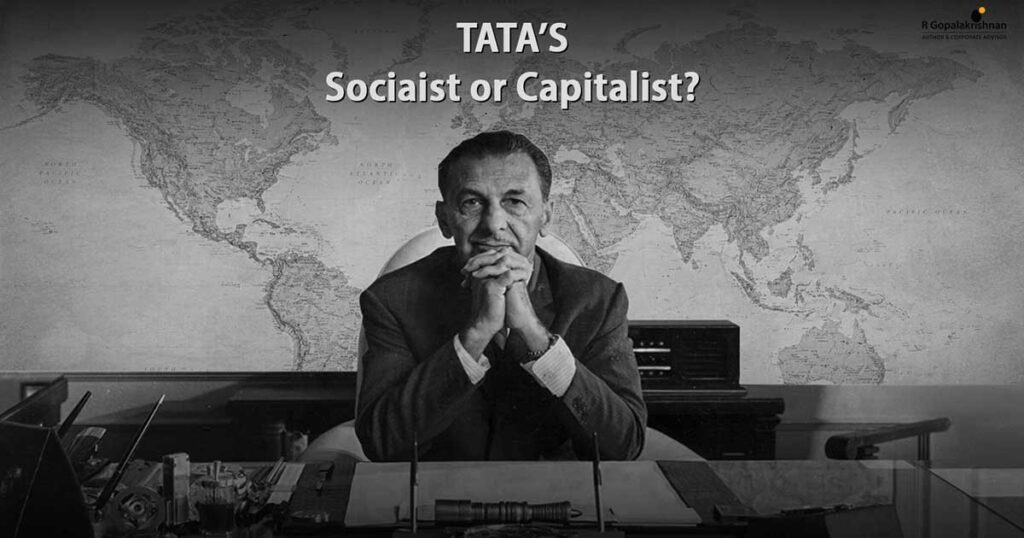
In the 1980s, journalist, Rajiv Mehrotra, interviewed JRD Tata for black and white TV. Upon learning about the TATA philosophy, investments, markets, and social contributions to the community, an intrigued Mehrotra asked whether TATA was capitalist or socialist. In his lilting French-accented voice, JRD replied that TATA is capitalist in some ways but is socialist in other ways. “Maybe TATA is a socialist capitalist,” he said with a shrug of his shoulders. JRD was a lifelong advocate of responsible and free enterprise.
Government struggles to facilitate enterprise because adipose bureaucratic tissues have accumulated over the decades into atherosclerosis. The World Bank Group stopped publishing their Doing Business Index due to data integrity issues. India’s most prominent votary that India has improved in ease of doing business now argues for reducing policy uncertainty.
According to government data, India has 65 million enterprises, of which only 200 hog the media reportage. Thinking tangentially, if we cannot find a bypass to our sclerotic business regulations, a Business Cockroach Party (BCP) could emerge to protest the Business Enterprises Endurance Tests (BEET). Therefore, we must explore a radically different model to actively promote Viksit Vyavasaya (Developed Enterprise) covering internal trade, exports, manufacturing, and innovation. India needs 10,000 enterprises of scale without worries about hundreds of regulations by many dozens of government departments.
If we can expand the contribution of manufacturing, exports, trade and commercial services from the current 65-70% by 10-15 percentage points, jobs can get created and GNP will accelerate. Bharat needs a bypass surgery, perhaps by recruiting the blockers to unblock the atherosclerosis. Here are three models; there are surely many others.
First model
Sam Altman of OpenAI has announced a 5% free stake to US government because the firm “seeks to clear political obstacles by securing financial buy-in from the Trump administration.” (FT, 2nd July). Government will not pay; it will get a free ownership stake for the firm to secure good relations with the administration. This may not suit us.
Second model
In his book, Beyond Punjab, Prakash Tandon recounted what led Lever Brothers, the predecessor of Hindustan Lever, to offer shares to the Indian public (not government) around 1956. After independence, T.T. Krishnamachari sequentially became commerce and finance minister of free India. He desired that Lever Brothers seek equity participation from the Indian public. Corporate headquarters in London initially resisted sharing equity. However, government’s firm nationalist stance catalysed the necessary transition. Thus, Hindustan Lever became one of the first foreign subsidiaries to offer stock to the Indian public (not government) in 1956. The action was to avoid angering government. This model is not relevant to ease of business.
Third model
The third model is an accidental product of license raj. With tweaks, maybe it has potential through assigning blockers to unblock.
In 1984, Tamil Nadu Industrial Development Corporation (TIDCO) invested Rs. 10 crores into the equity of a private enterprise called Titan Watches Ltd. That shareholding is now worth Rs. 100,000 crores, apart from rich dividends over many years! Here is the charming back story.
Xerxes Desai, then the CEO of Tata Press, identified wrist watches as a business opportunity in 1977. Watches were reserved for SSI (small scale industries) and the public sector in those days; HMT used to be the dominant domestic manufacturer, apart from a few small-scale firms. Tata Press tried to acquire a Bangalore based SSI watchmaker, Hegde and Golay, but this effort was unsuccessful.
After seven frustrating years of exploring options, Tata Press received an invitation from a government company, TIDCO (Tamil Nadu Industries Development Company), which had acquired an industrial license for watches. TIDCO invited Tatas to partner them equally in a joint venture. Their joint application to the Government failed for procedural reasons. Then, a small investment company named Questar Investments was established by TATA to consummate the joint venture. This worked!
The joint venture, named Titan – a name derived from Tata Industries (TI) and Tamil Nadu (TAN) – was established with technical collaboration with France Ebauches of France. Since inception, the Board of Titan has always been chaired by a nominee of TIDCO, which strictly played governance and facilitation roles, leaving management to Tata managers. TIDCO always behaved professionally with freedom to professionals, but willing to facilitate legitimate approvals and clearances for the company.
The TITAN narrative has been captured beautifully in a book (Titan by Vinay Kamath), based on which there is a recent Amazon MX film series, titled Made in India.
Conclusion
India desperately wishes to accelerate private capital formation and increase share of manufacturing and exports within the GNP pie but regrettably has only modest results to show. Should we consider a bypass surgery to promote enterprise, exports, research, and innovation? Maybe State Industrial Development Corporations (SIDCO) can pay for and participate in equity and play the role of guiding the entrepreneurs through the maze of regulations? This may coopt the ‘blocking community’ to deblock.
The ease of doing business attempts so far have generated more publicity than results. Government must consider how to act as a guardian angel for enterprise rather than interfere in operations, employment, and favours.
Bharat must decentralise Vyapaar from an increasingly centripetal Centre to the States.
By R. Gopalakrishnan*
*The writer is an author. His new book, CHANAKYA AND SUN TZU: a business lens on trade, thought, and travel, coauthored by Nirmala Isaac, has been published by RUPA in Feb 2026. His ID is gopal.mindworks@gmail.com