Many are sad that TATA is facing internal conflict. As retired directors, who together served TATA for many decades, the authors feel enormous pain. We feel that the dispute is existential.
Differences are common, but leaders can rely on proven methods to resolve disputes. Mahabharata and Ramayana, among others, suggest the method: (i) Apply Raja Dharma (ii) Seek compromise before conflict (iii) Protect both the institution and the weak (iv) Use wise advisors.
The Enterprise and Philanthropy institutions of Tata must align to avoid losing the plot. Together they are collaborators; individually, they become competitors. American investor Ray Dalio’s formula for nations applies equally to companies: educate your people, earn more than you spend, and avoid internal and external fights! The late Ratan Tata transformed a tradition-bound TATA into a growth-oriented, entrepreneurial organization. Based on what they read, however, the modern commentariat makes its own sombre prognostications.
Globally, the corporate world is seeing early signs of shared power rather than a single all-powerful CEO (Why co-CEOs might suit our tumultuous times, Pilita Clark, FT, 3rd May 2026). Future CEOs may be less able to exercise unidimensional power like their predecessors did. The styles of Jack Welch and Lee Iacocca have lower chance of success nowadays. Shared leadership styles must complement rather than compete.
Though leaders will seek power and glory, they must combine adaptiveness and humility. There is no magic formula to reconcile ambiguities. However, there is value in a self-questionnaire: (i) Do I listen enough? (ii) Do I shun cliques and gossip? (iii) Do my actions convey that the institution is bigger than myself? (iv) Are responsibilities clear so that there is tight accountability for results?
Our own epics suggest native wisdom regarding resolution of disputes.
Stories from Indian Epics
In the Mahabharata, Krishna undertook a peace mission to resolve the Pandava-Kaurava dispute over the rightful inheritance of the kingdom. Krishna proposed a compromise that the Pandavas would accept even a modest five villages. Duryodhana was adamant and arrogant. When disputes cannot be resolved by any means, then undesirable war and annihilation follow. Peaceful negotiations before war should never be abjured.
In the Ramayana, Sugriva complains to Rama about his brother Vali’s unjust act of taking away his wife and kingdom. As mediator, Rama listened to Sugriva’s plea, verifies his claim, and takes steps to restore Sugriva to the throne. Unfortunately, this meant killing Vali.
King Shibi’s story from Mahabharata and the Jataka tales is redolent of a Biblical story (Book 1 Kings 3:16-28), in which King Solomon intervened in a dispute between two mothers claiming the same baby as their own. King Shibi offered his own flesh to a predatory, hungry hawk to protect a fleeing, innocent dove. The denouement of the story demonstrates the act of personal sacrifice by King Shibi to protect Raj Dharma.
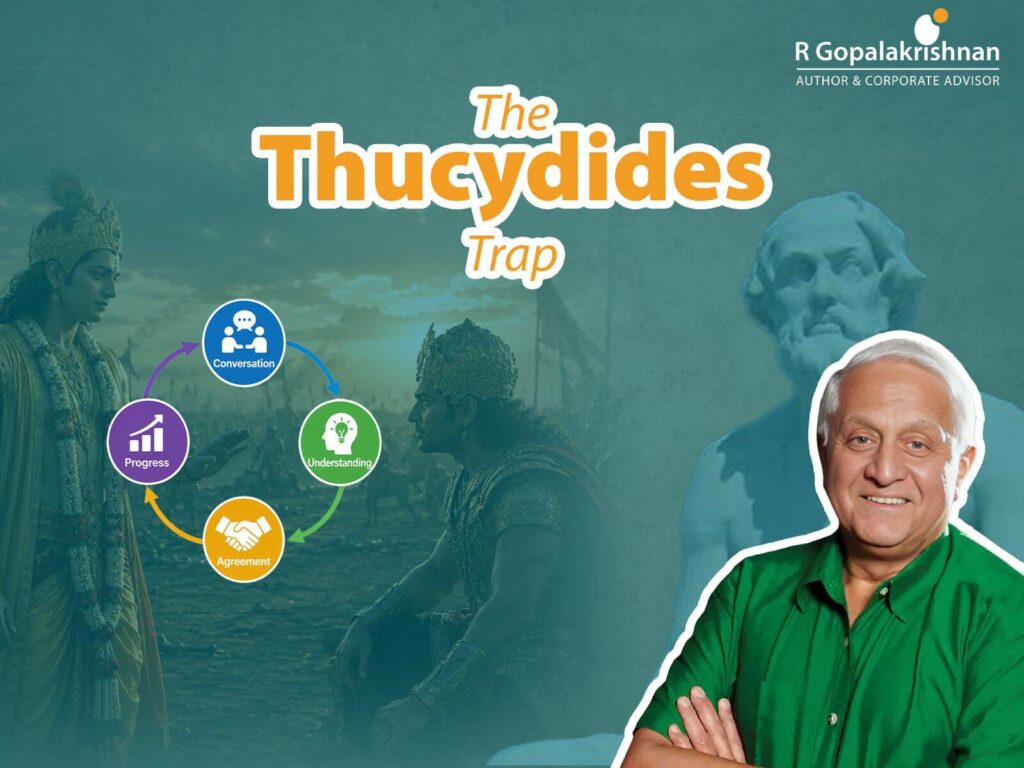
TATA faces the Thucydides trap, whereby the very acquisition of power by two parties increases their chances of conflict. Herein lie the dilemmas for the Tata Enterprise and Philanthropy leaders. Our memories are jogged by two long-forgotten Greek and Turkish stories.
The Persian Story
Emperor Darius II ruled the Persian empire for 17 years from 421-404 BCE with two sons, Artaxerxes the Elder, and Cyrus the Younger. Artaxerxes had the credential of primogeniture and was named as successor to Darius II. Cyrus was born after Darius II became king, hence he was ‘born into the purple’. Persian scholars opined that Cyrus could succeed Darius II. Both felt entitled. Cyrus mounted battle against Artaxerxes by recruiting Xenophon, along with 10,000 mercenaries. Xenophon was a great warrior, strategist, and philosopher. However, Cyrus died in battle. Artaxerxes ruled Persia for four decades.
What is relevant in this story is how conversations, congruence, and commitment were fruitful among people with low spirits and strongly different opinions when Xenophon led his fractious men out of enemy territories. He reframed the narrative, invoked ancestral pride, and encouraged rich conversations to achieve convergence and commitment. He was scholarly and had been a student of the wise Socrates. He was selfless but understood that it takes more than altruism to be an effective leader. That is how Xenophon learnt the 4 C lesson on conflict resolution–converting conflict into conversations, convergence, and commitment. How can opinionated leaders converse or converge while deeply embedded in power, ambition, and glory? History is useful only if we heed the lessons.
The Ottoman Story
Among the Ottomans, the temporal and the spiritual were combined in one leader, who acted as Sultan-cum-Caliph for centuries. The temporal had to succeed for the spiritual to be effective. During the 1914-1918 war, Sultan Mehmet VI was Ottoman Sultan-cum-Caliph. The temporal failed; Turkey became a republic and ceased to have a Sultan. Thereafter Abdul Mejid II became Caliph, but only for a short time. The lesson is that (a) there is strength in unity and (b) success of the temporal is a sine qua non for the spiritual to be effective.
The Corporate Story
In the 1990s, Lou Gerstner arrived at IBM with a hugely adaptive and inclusive approach; however, Carly Fiorina is held out as having the right strategy but less inclusive. The lesson for leaders is that they must combine artfully the skills of heart and mind because one or the other skill alone has less chances of success. Hubris poisons the mind of leaders. Lou Gerstner captured his experience through Who says Elephants Cannot Dance, and Carly Fiorina through Tough Choices. Xenophon wrote Anabilis from which I quote: “Your obstacles are not rivers or mountains or other people; your obstacle is yourself.”
Conflicting opinions and resultant conflicts have tested leaders forever. During the US President’s visit to China recently, following several months of aggressive statements, both the leaders opted for ‘constructive strategic stability’. The 4Cs of conflict resolution always help in reducing differences of opinion and personality, though with no guarantee of results.
Recall Plato, “Opinion is the lowest form of knowledge. It requires no accountability, no understanding …. highest knowledge requires purpose larger than the self.” Many centuries later, Ernest Hemingway famously said, “It takes two years to learn to speak and sixty years to learn to keep quiet.”
Although what we write appears simple and obvious, think how often leaders ignore such obvious simplicity. There is magic in the journey from conflict to conversation, and on to convergence and commitment. In every case, the institution should be treated as bigger than the individual leaders.
By R. Gopalakrishnan & Noshir Soonawala (*The writers were both Directors of Tata Sons and its several companies, both together for over seven decades.)